Generator Maintenance Plans
A standby generator sits idle for months, then has to carry the whole house the moment the grid goes down. Planned service is what makes that happen — oil and filter, spark plugs, battery, a real load test, and a full inspection, done on schedule and written down.
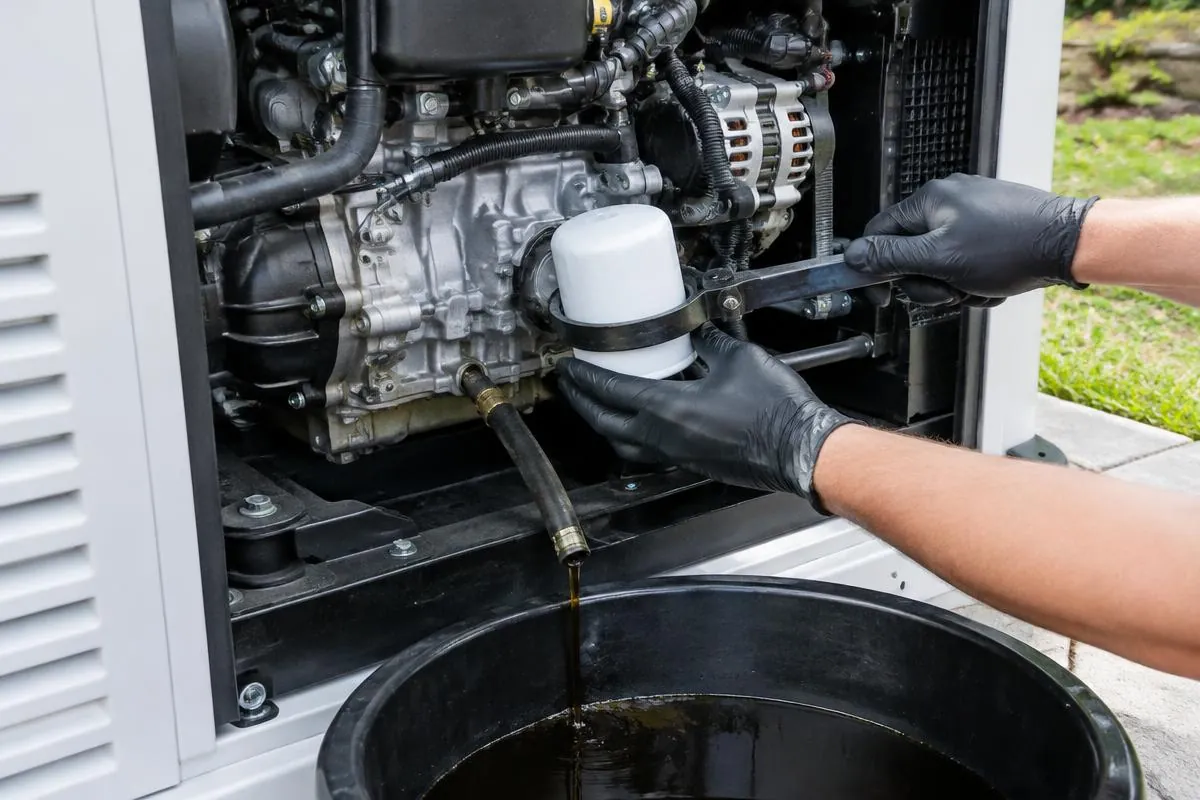
What annual service includes
A proper yearly service is a specific list, not a quick look. Here is what the installer does on every scheduled visit, and why each item earns its place.
Oil and filter change
The core of the visit. Engine oil in a standby generator breaks down from heat and from sitting, and old oil is what eats bearings. The installer drains it hot, replaces the filter, and refills to the correct spec for your model.
Run hours matter more than the calendar — a long outage burns oil faster than a year of sitting.
Spark plugs
Plugs foul and gap out, and a weak spark is the difference between a clean start and a unit that cranks and cranks. The installer inspects, services or replaces them on schedule rather than waiting for a no-start.
Plug condition also tells the installer how the engine has been running.
Battery check
The single most common reason a generator doesn't answer. The installer load-tests the battery, cleans the terminals, and checks that the charger is actually holding it up — a bad charger can hide for months.
If it cranks slowly, that's the battery talking. It gets tested before anything else.
Load test
Running on its own proves little; carrying your house proves everything. The installer puts real load on the unit — furnace, AC, the heavy stuff — and watches voltage and frequency hold under it.
A unit that starts fine and then quits at load is exactly what a load test catches.
Full inspection
The whole machine, opened up: fuel lines and connections, air filter, belts, coolant on liquid-cooled units, wiring and terminations, enclosure, louvers and airflow, and the transfer switch and its control signal.
Rodent nests, chewed harnesses and corrosion are found here, not from outside the box.
Controller and exercise review
The installer confirms the weekly exercise schedule is running and passing, reviews stored fault history, checks the controller settings and firmware, and makes sure it is set to AUTO.
Stored codes from weeks ago usually explain a problem before it becomes an outage.
The weekly exercise run does none of this. It circulates oil and charges the battery for a few minutes; it doesn't remove contamination, replace a filter, or tell you the battery is fading. That's why the manufacturer's service interval exists separately from the exercise cycle.
Why regular maintenance keeps the warranty valid
Manufacturers write maintenance into their limited warranties for a reason: a generator that never gets serviced is a generator that fails when it's needed, and the warranty is the manufacturer's way of pushing back on that. In practice, coverage depends on you doing two things — following the schedule, and being able to prove it.
The installers we connect you with are independent local contractors, not dealer agents for any manufacturer, so they can't waive or extend a warranty. What they can do is perform the service the manual calls for and hand you the paperwork that shows it happened. Check your own warranty terms for the exact interval and requirements.
Read the terms in your paperwork
Most limited warranties on home standby generators are conditioned on the unit being installed and maintained according to the owner's manual. The exact interval, and what voids coverage, is spelled out in your warranty documents — not in a sales pitch.
The interval is usually run-hours or a year
Manufacturers typically require service at least once a year, or after a set number of run hours — whichever comes first. Homes that saw a long outage can hit the run-hour mark well before the anniversary.
Undocumented service is the usual denial
A claim can be refused not because maintenance was skipped, but because nobody can prove it happened. A dated record of who did the work, when, and what was replaced is what protects you.
Every visit gets documented
You get a written service record after each visit — items checked, parts replaced, test results. Keep it with your warranty paperwork. The installer services units regardless of who installed them, and follows the schedule in your manual.
Planned service
Maintenance plans
Two ways to keep a unit on a schedule, offered through the local, licensed and insured installer we match you with. Pick by how the house actually runs — outage history, loads, and whether you're on the calendar interval or the run-hour one.
Annual Service Plan
One scheduled visit a year
Most homes. The standard factory service interval for a unit that exercises weekly and rarely carries long outages.
- Oil and filter change
- Spark plug inspection or replacement
- Battery load test and terminal service
- Air filter, belts and coolant check
- Fuel line and connection inspection
- Full load test with your real household loads
- Transfer switch operation and control-signal test
- Controller review, fault history and exercise schedule
- Written service record for your warranty file
Pre-Season Check
One short visit before winter or before summer
Homes already on a service schedule elsewhere, or a unit that has been sitting through a long season and needs proving out before the loads come back on.
- Start test and exercise-cycle verification
- Battery and charger test
- Fuel supply and shutoff check
- Visual inspection for rodents, debris and corrosion
- Transfer switch operation test
- Written report of what passed and what didn't
No prices on this page on purpose. Plan pricing depends on your unit's size, fuel type, where the installer is coming from, and whether anything already needs fixing. Call or send a request and the installer gives you a written figure for your specific unit before anything is scheduled — and see what drives generator cost if you want the bigger picture first.
How a planned visit runs
Four steps, and you leave with a record — not just a receipt.
Tell us what you have
Model number, fuel type, and when it was last serviced. If you don't know the last service date, that's normal — the installer starts from the nameplate.
The installer schedules the visit
A planned date, not a waitlist, set with the installer when you're matched.
Service and test
Fluids, plugs, battery, filters, inspection — then a real load test and a full transfer cycle: house off to generator power, and back on when utility power returns.
You get the record
A written summary of the work and test results, plus anything the installer found that isn't urgent yet — so you can decide now instead of in a storm.
Fuel and gas supply get checked, not assumed
A unit that starts then dies under load is often starved rather than broken. The installer checks the shutoff at the unit, the line and its connections, and the supply pressure, because a regulator drifting out of spec is a slow problem that shows up as a fast one.
Serviced by someone else before? Still fine
The installers we work with maintain and repair standby generators regardless of who installed them. Bring whatever records you have; they'll work from the nameplate if you have none.
Put your unit on a schedule
Tell us the model and when it was last serviced. We'll match you with a local installer who can tell you which plan fits how your house actually runs, quote it in writing for your unit, and book the visit.
More to read
- Generator repair and service — if the unit is already showing a fault, warning light or a skipped exercise run, that's a diagnosis, not a service.
- Standby generator cost in Naperville — what actually drives the price of equipment, installation and ongoing service.
- Contact us — send the model number and the installer will quote a plan for your unit in writing.